

The Kaleidoscope System emerged during my teenage years, and has been turned upside-down several time since then.
The Beginnings
After my first years of computer science lessons, an idea took form: Inspired by various video games, I thought about creating one of my own that combined my favorite elements from them. I wanted an explorable world full of adventure, and virtual characters that you could befriend – or not, depending on the circumstances.
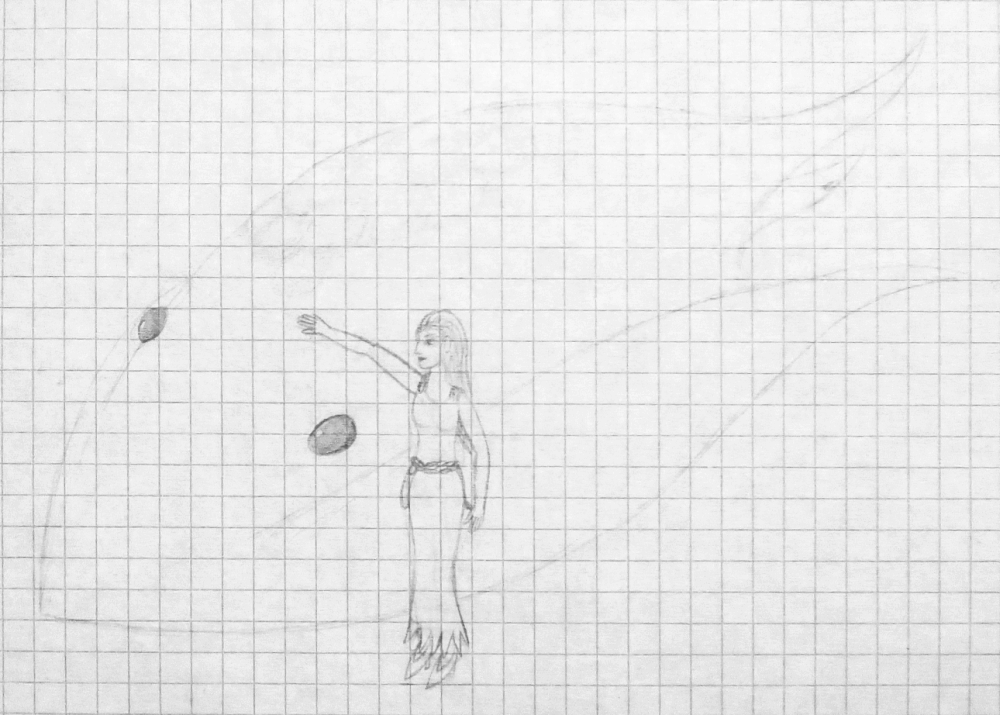
The first two characters I envisioned for it were Calyrra, the intended protagonist, and Ycalla, the living space ship that would kick off the plot.
Using the usual tamagotchi methods – feeding, playing, cuddling and so on – the former would gain this creature’s trust until it finally invited her to fly across the star system together.
Soon after that, two more factions emerged for them to meet out there. One was the technologically advanced population of Ranul, a moon circling the lava planet Xavoa. The second group were the priestesses on Temroph, a small planet at the very rim of the star system. Initially I wanted to populate two more planets, but those ideas never really took hold.
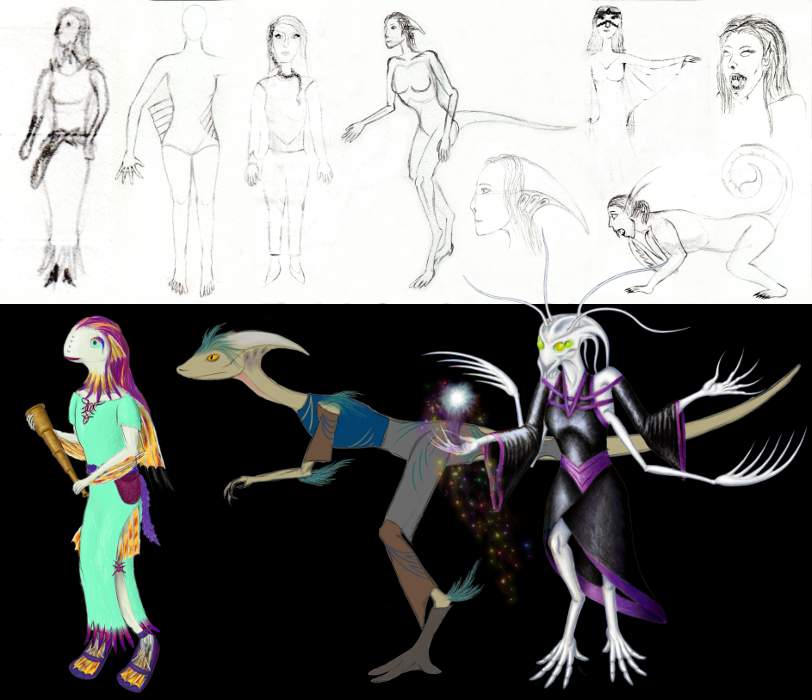
Originally, all inhabitants of this system looked extremely human-like, despite having no connection to Earth whatsoever. They mainly differed with regards to colorful hair, eccentric make-up, and exotic clothing.
Near the end of my school years, I started redesigning the three species to make them notably alien. The priestesses received insectoid traits, the inhabitants of Ranul became skinny reptiles, and Calyrra’s people gained fins.
A few years after the first ideas, I added the concept of a “stream of magic” from which the priestesses would get their supernatural powers.
This stream would run along the rim of the star system and influence the inhabitants. Among other things, it had greatly contributed to the emergence of life there.

At some point early into my study years, I realized that I would like to have an element of randomness in the game, such as levels that would be set up differently on every playthrough. Basically, a collection of building blocks that would constantly be rearranged into new pictures – like the fragments inside the toy kaleidoscope I used to have as a child. Suddenly, the project had a name – and so did the force that drives change in the star system.
By now, the Kaleidoscope is a cosmic phenomenon that emits a colorful mix of electromagnetic radiation across the entire spectrum. This, in turn, defined how the priestesses would work their magic or how Ycalla would achieve the camouflage she had gained in the meantime. The fundamental principle was the use of those energies to disassemble and recombine matter on the subatomic level… which brings us back to the colorful fragments in the toy kaleidoscope.
First Steps Towards Implementation
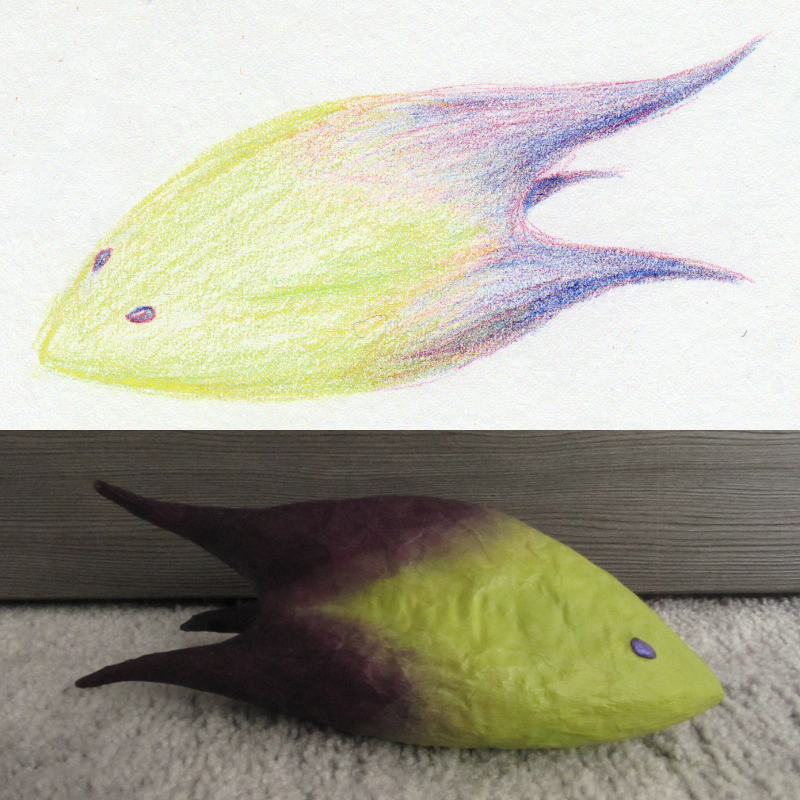
Sadly, the project had to step back behind my studies and the full-time employment that followed. Apart from a few concepts, I made very little progress for several years – but nevertheless, this world was always in the back of my mind. In my first university semester, I crafted a sculpture of Ycalla. The first time I was sent to a conference as a student assistant, I gathered ideas on research that might be useful for development. Names and plot fragments popped up in different points of my daily life, and the game scenario of my Master’s thesis was inspired by events that should take place in this world.
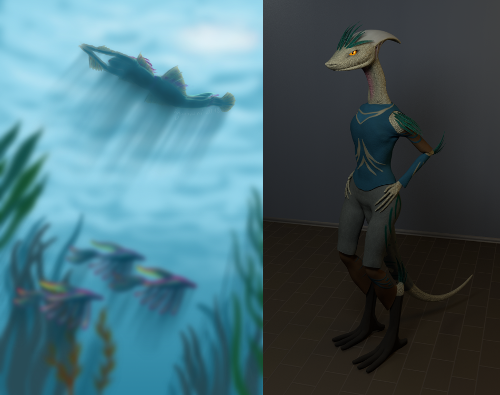
Between 2016 and 2023 I actively worked on filling the Kaleidoscope World with life. The cultures in the star system became more concrete, more characters joined the cast, and I composed music for it.
To practice for the main game around Ycally and Calyrra, I started a smaller game set in Ranul’s past and recorded my work on it in a development blog.
Current State
In early 2022, it dawned on me that a major obstacle was in the way of the project – branching game narratives are difficult to design when you already lack experience with telling a linear story. I started consuming advice for writers, but the fundamental problem remained. I needed a linear story that I could use to practice.
The fact that my doctoral thesis was nearing completion did not help. University took center stage again and devoured most of my time and energy.
At the end of 2022, a different project appeared out of the blue – the story of Ria’s Pack, along with the potential for a novel series. While it was set in an entirely different world, it is exactly the kind of linear narrative that will allow me to hone my storytelling skills.
Since then, the Kaleidoscope system is on hiatus, and right now, I can’t say for how long. But I know that I will return from this trip to Miragia with valuable experience.